

Sandra Eleta: What a Nation Chooses to Remember

Sandra Eleta was born in Panama in 1942. She studied art history and photography in New York and also took courses at the New School for Social Research. After teaching photography in Costa Rica, she returned to Panama in 1974 and eventually divided her life between Panama City and Portobelo, on the Caribbean coast.
That return became central to her photography.
Eleta was interested in the lives that rarely dominate the official image of a country: rural communities, Afro-Panamanians, Indigenous people, domestic workers, farmers, children and elders. Over the decades she created bodies of work including Las campesinas, La servidumbre, Emberá: Hijos del río, Los abuelos and, most famously, Portobelo.
Her approach was unusually personal.
When she began photographing in Portobelo in the 1970s, she did not arrive, take pictures and leave. She lived there. She knew the people she photographed. Eleta later wrote that she began with those who felt closest to her and moved nearer to them until their presence could enter the photograph. Her Portobelo work developed through years of relationships built on trust and respect.
That changes what documentary photography can do.
Instead of looking at a community from the outside and asking, What is unusual here?, Eleta's photographs ask us to recognize the knowledge and history already present in ordinary lives.
When history forgets, culture remembers.
Kéa, made in the 1970s, is part of this larger body of work in which Eleta turned her camera toward people and traditions existing outside the usual centers of political and economic power.
Panama is known throughout the world through one enormous piece of infrastructure: the Canal. Its geography made it strategically important to empires, governments and international commerce for centuries.
But a country cannot be understood only through the things governments build or the events that make history books.
There is another kind of history carried quietly through generations: in clothing, ceremonies, language, gestures, relationships to land and water, and in what families teach their children.
Those things rarely arrive with monuments or official archives.
Sometimes a photograph becomes the archive.
Eleta's work repeatedly brings those parallel histories into view. The people she photographed are not illustrations accompanying someone else's account of Panama. They occupy the center of the frame.
Kéa becomes important for precisely that reason. The photograph asks a larger question: who gets remembered when a country tells its own history?
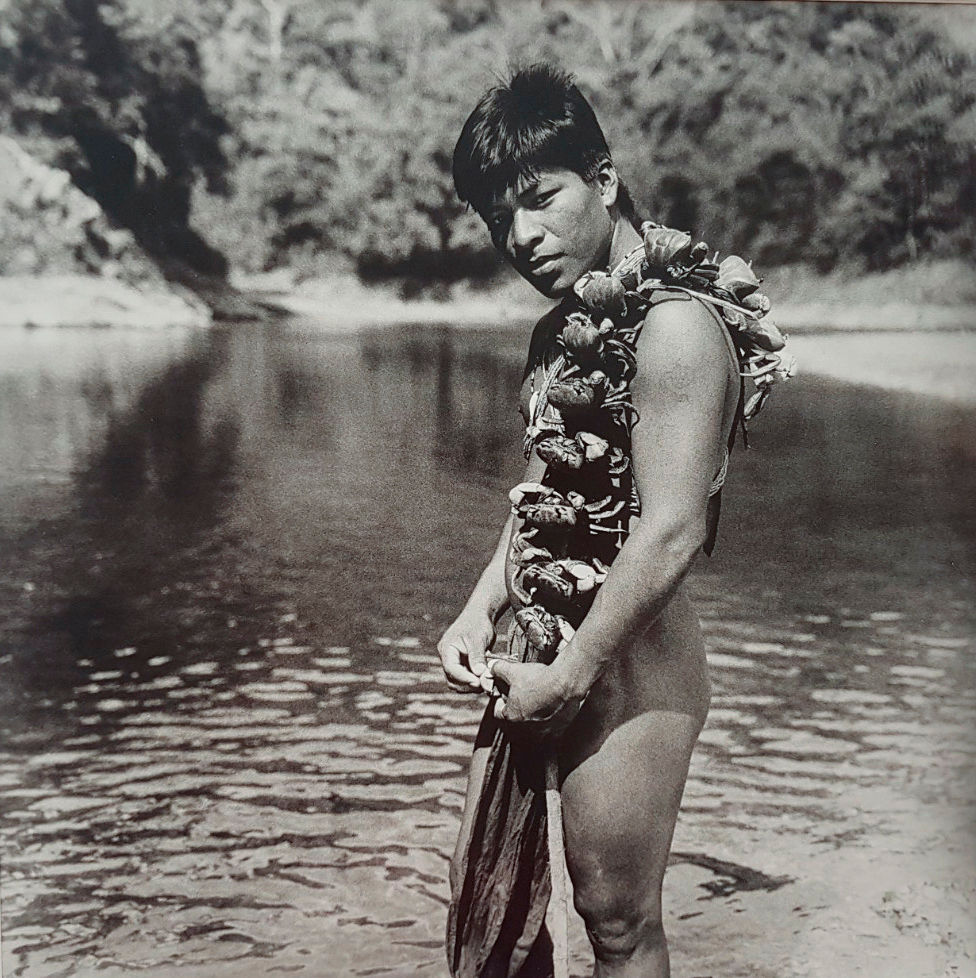
Survival is knowledge passed down.
Campejero, also dated to the 1970s, takes us toward another kind of knowledge.
Modern societies often confuse technological progress with knowledge itself. We become very good at measuring what is new and much less interested in understanding what has worked for generations.
But survival has always depended on accumulated knowledge: when to plant, where to fish, which waters to cross, what animals can be found where, how seasons change, how food is gathered and prepared, and how skills pass from one person to another.
Much of that knowledge was never written down.
It was learned by watching.
Then by doing.
Then by teaching someone younger.
Eleta's broader archive repeatedly returns to this kind of life. Her photographic essays are filled with workers, farmers, fishermen, domestic labor, ceremonies and families — not as background to Panama's history, but as people who made that history possible.
Her later project Los abuelos makes that idea particularly clear. Commissioned around Panama's centenary, it brought her face-to-face with elders whose memories connected family life to events she had previously encountered mainly through schoolbooks. Eleta herself wrote that she had never confronted the history of her country in that way before — through people's presence and testimony rather than at the distance of written history.
That idea was already present in photographs such as Kéa and Campejero decades earlier.
Sandra Eleta did not simply document how people in Panama looked in the 1970s.
She built an archive in which their knowledge, culture and individual presence counted as part of the historical record.
And because of that archive, it becomes much harder to tell Panama's story as though the Canal, governments and cities were the whole country.


Comments